
Some of the numbers presented in this website may not be the most recent available
globalshift.co.uk - copyright © 2009 to 2026; All rights reserved


Global Warming
Mostly driven by increased carbon dioxide and methane in the atmosphere, it leads to changes in the Earth’s climate.
Unless stopped the changes will eventually have a catastrophic effect on human populations and society.
The Greenhouse Effect
Solar energy reaches the Earth’s surface and radiates back into space. The Greenhouse Effect traps some of the Sun's energy in the Earth's atmosphere. Without it the Earth would be colder and most life would be unsupportable.
Energy is absorbed by so-called greenhouse gases and re-emitted in all directions within the lower atmosphere, heating it.
Greenhouse gases occur naturally but large volumes are now released as a result of burning fossil fuels, as well as a by-product of agricultural and industrial processes.
Humans are thus adding to the natural greenhouse effect, trapping more solar energy and causing rapid global warming.
The Issue
Forecasts of oil and gas supply, and indeed of all energy sources, need to include consideration of how potential legal and social curbs on the use of carbon fuels will impact their use.
In 2020 the Earth's average temperature was around 15 degrees Celsius with human emissions of carbon dioxide of perhaps 32 bn tonnes. The temperature had risen from 13.5 degrees in the 1950s when human emissions of carbon dioxide were at around 5 bn tonnes.
Growing populations and increasing affluence over the last half century have led to an unprecedented growth in the use of fossil fuels. This, in turn, has resulted in higher carbon dioxide emissions into the atmosphere, raising atmospheric temperatures.
Higher temperatures lead to, in particular, extreme weather events, melting polar ice caps, and fluctuations in oceanic currents - climate change.
Global temperatures have been much higher (and lower) during in the past. For example during the Mesozoic when the dry, continental conditions of the Triassic were replaced by the warm, humid climate of the Jurassic.
Dense tropical forests covered much of the landscape at high latitudes and temperatures averaged around 21 degrees.
At this time the forests were surrounded by warm organic-rich lakes and seas leading to the irony that vast quantities of the earth’s oil source rocks being deposited.
However, natural temperature rises in the Jurassic, or at any other time, are irrelevant to our concerns over present-day climate change.
Firstly, the natural fluctuations were usually much slower than they are today. Living things had time to migrate, adapt and/or evolve as conditions changed.
Secondly, human society has today overwhelmed nearly every ecosystem on earth, erecting physical and social barriers to movement. Billions of people not only do not want to adapt, but also they have nowhere to go. This particularly applies to those inhabiting urban environments.


Greenhouse Gases
These are many and varied. The most effective greenhouse gas is water vapour but it stays in the atmosphere for just a few days.
Carbon dioxide is less effective at trapping heat and is absorbed by plants and by oceans. However, most of it remains in the atmosphere for hundreds of years and, as greater volumes are produced, they build up over time. Perhaps a little over 80% of the global warming driven by human activity is attributable to carbon dioxide. Carbon dioxide is released during the burning of fossil fuels (coal, oil and gas).
Meanwhile trees that would absorb carbon in the world’s forests are being progressively cut down. Furthermore their destruction releases stored carbon which adds to global warming.
Methane is an especially effective greenhouse gas. An equivalent volume of methane over a hundred year period can warm the earth 25 times more than carbon dioxide although it has a much shorter life in the atmosphere. Methane is emitted during the production and transport of fossil fuels although this is on a downward trend. A growing source of methane emissions arises from livestock and by the decay of organic waste in landfill. Perhaps 10% of global warming driven by human activity is attributable to methane.
Other industrially produced gases, including nitrous oxides, contribute a little under 10% to the overall global warming effect.
Since the industrial revolution in Europe carbon dioxide levels in the atmosphere have risen by over 30%. Concentrations are now higher than at any time in at least 800,000 years. Carbon dioxide is almost certainly responsible for most of the atmospheric rise in temperature over the last 50 years.
There is now a political effort to stabilise greenhouse gas emissions although with much dissent and disagreement. China emits more carbon dioxide than any other country followed by the USA, European Union member states and the UK.
Of course China not only has a large population making emissions per person lower but also much of China’s manufacturing output (and attendant emissions) are destined for use in, and thus ultimately attributable to, the USA and Europe.

LAND TEMPERATURE (degrees C) RELATIVE TO AVERAGE 1951-1980
Globalshift.co.uk (source: University of California Berkeley)
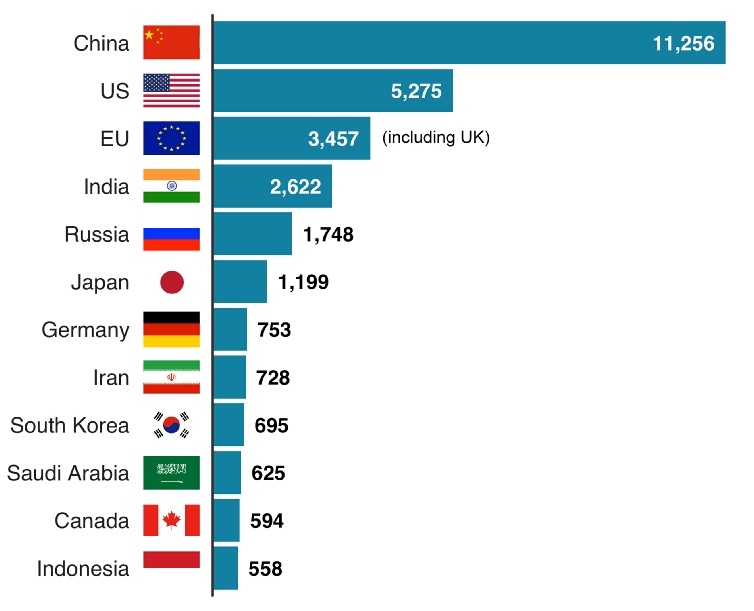
TOP EMITTERS OF CARBON DIOXIDE IN MEGATONNES PER YEAR
Globalshift.co.uk (source: Emissions Database for Global Atmospheric Research 2018)
The changing earth
The world is now about 1.5 degrees warmer than it was before widespread industrialisation in the 1960s. Furthermore, the 20 warmest years on record have all occurred in the past 20 years with 2023 the hottest of all.
Global average sea level has increased by 3.6 mm per year in the last 15 years. Global sea level may have risen by 10-20 cm over the last 100 years.
Although water increases in volume as it heats up melting ice is believed to be the main cause of rising sea levels. Glaciers in temperate regions of the world are retreating and satellite records show an extensive and progressive decline in the size of the Greenland Ice Sheet. The maximum areas of winter and summer Arctic sea-ice have also contracted over the last 40 years.
The world's largest potential source of sea level rise is the East Antarctic Ice Sheet which holds enough ice to raise global sea levels by over 50m although it will probably never melt completely. Furthermore ice reflects heat back into the atmosphere so its loss has other implications.
The effects of rising temperatures can be seen in climate and the behaviour of vegetation and land animals. Earlier flowering and fruiting times for plants in temperate regions are accompanied by territorial adaptation and migration of animals to cooler latitudes. In addition there seems to be an increased occurrence of extreme weather events although it remains uncertain whether these are a by-product of global warming.
Future temperatures
Should warming continue at the same rate, temperatures could rise by up to 5 degrees by the end of the 21st Century. Temperature rises of above 2 degrees were once regarded as the tipping point for drastic global disruption.
However, in the last few years there has been general acceptance that only by limiting temperature rises to 1.5 degrees can significant loss of habitat and life be prevented. An Intergovernmental Panel on Climate Change (IPCC) report in 2018 concluded that keeping to this target would require "rapid, far-reaching and unprecedented changes in all aspects of society". It is not being achieved.
But even if greenhouse gas emissions can be dramatically reduced, there will be a time lag. Large bodies of water and ice take hundreds of years to respond to small changes in temperature and it takes decades for carbon dioxide to leave the atmosphere.
Of course there is uncertainty about how the changing climate will impact lives. The real problem lies not in the temperature but in the speed of change. Rapid rises in sea level under current constraints of high populations and barriers to movement make it impossible for humans to adapt without massive social and economic damage.
Human impact
As the world warms water evaporates leading to more moisture in the air. Many areas will experience more rain and snow. Inland areas will get less rainfall and droughts will become more common. As storms escalate and sea levels rise flooding will become more widespread.
Warming could cause freshwater shortages, change the ability of areas to produce particular foods, increase the disruption from floods, storms and heatwaves, and promote resource wars amongst people and nations. And poor, densely populated countries, which are least equipped to deal with rapid change, will suffer the most.
Plant and animal extinctions will escalate as habitats change faster than species can adapt. And there will be increases in health issues, especially water-borne diseases and malnutrition in poor countries. As more carbon dioxide is present in the atmosphere, the concentration of gas in the oceans will increase. Water then becomes more acidic which damages coral reefs.
Meanwhile feedback processes create further heating such as through the release of trapped methane from high latitude permafrost. Should oceanic currents in, for example, the North Atlantic, be disrupted this would produce rapid and dramatic changes in climate over large areas.
Oil and gas
The world is confronting a second huge challenge and, like global warming, it has been encroaching for years - the phase out of oil and gas. In concert with pressures to reduce fossil fuel use comes a decline in EROI, an acronym for the Energy Return on Investment, the ratio of the amount of energy delivered from a resource to the amount used to obtain that resource.
For over two thousand years slaves supported civilisation but, following the Industrial Revolution, humanity began to depend on stored solar energy from coal and then from oil and gas. Used for transport, heat and cold, and materials too (concrete, metals, plastics and fertilisers), oil and gas have increased human capacity a hundred fold. They have become fundamental to our standard of living, indeed our capacity to stay alive.
But, although huge volumes remain in the ground, the easy pickings are long gone. New reserves are deeper in the earth, deeper under water, and in remoter more formidable environments. Meanwhile, as demand for oil and gas has soared and supply routes multiplied, ever more sophisticated equipment has been required for their extraction, processing and transport all of which needs energy, and lots of it.
Of course there is no doubt, at least for most of us, that burning oil and gas has damaged our environment and we are facing an existential threat to the world’s current climate balance on which 8 billion people depend. We must use less even as the EROI dwindles but new cleaner sources also require substantial amounts of energy to exploit and other things like graphite and rare metals, for magnets, batteries, and electronics.
Thus, along with a changing climate, we have less net energy and scarce materials too, leading to resource nationalisation, high costs and inflation - a recipe for human hardship and, of course, resource wars.
Mitigation
And what are we doing to counteract this perfect storm? The energy and transport industries try to develop cost-effective alternatives, convert to electrified transport and experiment with carbon capture while other organisations make things worse, attempting to ‘stop oil’ and damage economies in the countries most active in tackling the challenges. A reduction in the financial strength of commercial organisations and governments can only reduce the capacity to pay for new technology and infrastructure, and implement strategies to mitigate the effect of a changing climate.
Climate change is happening and needs to be stopped. But we should also continue to provide sufficient energy for all 8 billion people to live safely when ‘clean’ energy supplies remain insufficient to meet our needs. Only by retaining oil and gas in a controlled phase-out can some human death and destruction be, perhaps, avoided.
Many oil and gas professionals, who have strived their entire lives to explore for and sell a life-enhancing product, are loath to admit that their work is harming millions of people. Of course they are no more to blame than energy users who have enjoyed decades of transport growth and can visit cheaply and easily most parts of the world. We are all to blame.
The fossil fuel industry is dying. Unless carbon capture techniques can be perfected (an unlikely outcome) the oil and gas industry, along with the coal industry is destined to be almost gone in a hundred years regardless of how much resources remain to be found.

CARBON DIOXIDE EMISSIONS BY REGION IN BILLION TONNES
Globalshift.co.uk (source: Carbon Dioxide Information Analysis Centre)